
Game of Life
Create Conway's Game of Life simulations and animations, directly in your browser.
This free online Game of Life simulator runs Conway's Game of Life, the most famous cellular automaton ever created: a grid of cells where each cell is born, survives or dies depending only on how many live neighbors it has. From those three simple rules come gliders, oscillators, glider guns and patterns that keep growing forever.
Choose a starting pattern (a random soup, a glider, the Gosper glider gun, the R-pentomino, the pulsar...) or draw your own pattern with the mouse directly on the grid. Change the rule to HighLife, Seeds, Day & Night, Maze or any other of the 23 rule presets, or write your own rule in the B3/S23 notation, even while the animation is running.
Customize the size of the grid, the colors, the shape of the cells, the fading trails and the glow, then download the animation as a video or save any generation as a PNG image.
Everything runs directly in your browser: nothing is uploaded to a server. You are free to use the generated images and videos anywhere, and attribution is not required but appreciated.
Generation: 0Live cells: 0Grid: 120 x 80Rule: B3/S23
Draw cells with the left button of the mouse, erase them with the right button.
How to create a Game of Life simulation
- Choose the initial pattern - Start with a random soup to watch the classic behavior of the Game of Life, or pick one of the famous patterns: a glider, the Gosper glider gun, the pulsar, the R-pentomino, the acorn...
- Draw your own cells - Click and drag on the grid with the left button of the mouse to create cells, and use the right button to erase them. You can draw while the animation is running, and watch how your pattern reacts.
- Choose the rule - Keep Conway's original rule (B3/S23), or try one of the 23 presets: HighLife, Seeds, Day & Night, Maze, Replicator, Coral and more. You can also write your own rule in the B3/S23 notation.
- Set the size of the grid - Choose the number of columns and rows and the size of each cell, in pixels. The size of the grid multiplied by the size of the cell is the size of the image and of the video you download.
- Adjust the speed - Choose how many generations are computed per second, or turn on the maximum speed to run the simulation as fast as your browser can.
- Customize the colors - Paint all the cells with a single color, or color them by age with a gradient or a rainbow, so you can see which cells have been alive the longest. Add fading trails and a glow for a neon look.
- Use the controls - Start, pause, resume and stop the animation, or click "Next generation" to advance one single step and study the rule in detail.
- Download it - Save the current generation as a PNG image, or open the "Generate and download video" section to record the animation as a video in WebM format.
What is Conway's Game of Life?
The Game of Life is a cellular automaton invented in 1970 by the British mathematician John Horton Conway, and made famous by Martin Gardner in his column in Scientific American. It is a "zero player game": you only choose the pattern of the first generation, and everything that happens next is decided by the rules alone.
The board is a grid of square cells, and every cell is either alive or dead. Each cell looks at its 8 neighbors (the Moore neighborhood: the 4 cells that share a side and the 4 that share a corner) and the whole grid is updated at the same time, generation after generation, using three rules:
- A live cell with fewer than 2 live neighbors dies, as if by underpopulation.
- A live cell with 2 or 3 live neighbors survives to the next generation.
- A live cell with more than 3 live neighbors dies, as if by overpopulation.
- A dead cell with exactly 3 live neighbors becomes alive, as if by reproduction.
That is all. Those four lines are written as B3/S23: a cell is born with 3 neighbors, and it survives with 2 or 3. And yet, from that tiny rule come patterns that move, patterns that repeat forever, patterns that build copies of other patterns, and patterns that grow without limit. The Game of Life is Turing complete: it is possible to build a working computer inside it.
The families of patterns
| Family | Description |
|---|---|
| Still lifes | Patterns that never change, like the block, the beehive, the loaf and the boat. A random soup always leaves a lot of them behind. |
| Oscillators | Patterns that come back to their initial shape after a fixed number of generations, called the period. The blinker has period 2, the pulsar has period 3 and the pentadecathlon has period 15. |
| Spaceships | Oscillators that come back to their shape in a different place, so they travel across the grid: the glider and the lightweight, middleweight and heavyweight spaceships. |
| Guns | Patterns that stay in place and shoot spaceships forever, like the Gosper glider gun. They grow the population of the grid without any limit. |
| Methuselahs | Tiny patterns that take a very long time to settle down, like the R-pentomino (1103 generations), the diehard (130 generations) and the acorn (more than 5000 generations). |
The initial patterns
These are the patterns you can choose as the first generation of the simulation. All of them are the classic patterns of Conway's Life, and they only behave as described with Conway's rule (B3/S23).
| Pattern | Description |
|---|---|
| Random soup (the whole grid) | Fills the whole grid with random live cells. This is the usual way to watch the Game of Life: the soup boils for a few hundred generations and leaves behind still lifes, blinkers and a few gliders. |
| Random soup (center of the grid) | The same random soup, but only in a square at the center of the grid, so you can watch the colony expand into the empty space around it. |
| Empty grid (draw your own pattern) | Starts with an empty grid, so you can draw your own pattern with the mouse and watch what happens to it. |
| Glider | The smallest and most famous spaceship: 5 cells that walk diagonally across the grid, one cell every 4 generations. |
| Lightweight spaceship (LWSS) | The smallest of the orthogonal spaceships: it travels sideways at half the speed of light of the Game of Life. |
| Middleweight spaceship (MWSS) | A bigger brother of the lightweight spaceship, with one extra cell in front of it. |
| Heavyweight spaceship (HWSS) | The largest of the three classic orthogonal spaceships, travelling at the same speed as the other two. |
| Gosper glider gun | The first pattern ever found that grows forever: it shoots a new glider every 30 generations. It proved that the Game of Life can create an unlimited number of live cells. |
| Pulsar | The most common large oscillator: it repeats itself every 3 generations and is beautifully symmetric. |
| Pentadecathlon | An oscillator with a period of 15 generations, which is why it is called after the decathlon. |
| R-pentomino | The most famous methuselah: only 5 cells, but they keep changing for 1103 generations before settling down, and they throw 6 gliders away. |
| Acorn | Seven cells that take more than 5000 generations to stabilize, and end up covering a huge area of the grid. |
| Diehard | A pattern of 7 cells that survives exactly 130 generations and then disappears completely. |
| Infinite growth (5x5) | One of the smallest patterns known to grow forever: only 5x5 cells, and it never stops producing new ones. |
| Single cell | One single live cell in the middle of the grid. It dies immediately in Conway's Life, but it grows into a fractal with the Replicator and the Gnarl rules. |
| Solid square | A solid block of 20x20 live cells. It is a good way to compare how the different rules react to the same starting shape. |
The rules
A rule of this family of cellular automata is written as B followed by the numbers of live neighbors that create a new cell, then a slash, then S followed by the numbers of live neighbors that keep a live cell alive. Everything else dies. Conway's Life is B3/S23, and changing those few digits completely changes the universe of the simulation.
| Rule | Description |
|---|---|
| Conway's Life (B3/S23) | The original rule, created by John Conway in 1970. It is the only rule of this list where gliders, glider guns and the whole zoo of the Game of Life appear naturally from a random soup. |
| HighLife (B36/S23) | Conway's Life plus the birth with 6 neighbors. It behaves almost like the original rule, but it has a replicator: a small pattern that copies itself forever. |
| Day & Night (B3678/S34678) | A symmetric rule: a pattern of live cells on a dead background behaves exactly like the same pattern of dead cells on a live background. It grows into large organic blobs. |
| Seeds (B2/S) | Every live cell dies in the next generation, and a dead cell with exactly 2 neighbors is born. Everything explodes into a fast growing cloud of sparks. |
| Replicator (B1357/S1357) | Every pattern copies itself, over and over, into a fractal made of copies of the pattern you started with. Start with a single cell to see it. |
| Life without death (B3/S012345678) | Live cells never die, so the pattern only grows. It fills the grid with mazes, ladders and long corridors. |
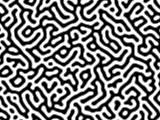
| Maze (B3/S12345) | Grows a maze of narrow corridors from a small random seed. Perfect to generate labyrinth textures. |
| Mazectric (B3/S1234) | A variant of the maze rule that produces longer and straighter corridors. |
| Coral (B3/S45678) | Slowly grows thick, rough structures that look like coral or lichen. |
| Diamoeba (B35678/S5678) | Large amoeba-like blobs with a ragged border, that keep eating and rebuilding themselves. |
| Anneal (B4678/S35678) | A majority rule: it smooths a random soup into big rounded regions, like a metal cooling down. |
| Move (B368/S245) | A rule full of spaceships and puffers, where most of the patterns end up travelling across the grid. |
| 2x2 (B36/S125) | A rule where patterns made of 2x2 blocks keep their block structure forever. |
| Serviettes (B234/S) | No cell ever survives, so every generation is born from scratch. It draws delicate lace patterns that expand from the center. |
| Gnarl (B1/S1) | A single live cell grows into a beautiful, intricate and endless fractal. |
| Assimilation (B345/S4567) | The structures absorb each other and settle into large, stable and very symmetric shapes. |
| Coagulations (B378/S235678) | The pattern grows forever, leaving a trail of chaotic clots behind it. |
| Walled cities (B45678/S2345) | Grows walled areas with a boiling interior, that look like cities seen from above. |
| Amoeba (B357/S1358) | A chaotic rule that builds large regions with the texture of an amoeba. |
| Pseudo life (B357/S238) | Looks a lot like Conway's Life at first sight, but none of the famous patterns work in it. |
| Long life (B345/S5) | Small patterns take a very long time to stabilize, and usually end as a set of oscillators. |
| Stains (B3678/S235678) | Most patterns grow until they fill the grid with stains that keep changing at their border. |
| Vote (B5678/S45678) | Every cell takes the state of the majority of its neighborhood, so a random soup quickly freezes into big round islands. |
Options
Below are all the options you can configure in this Game of Life simulator.
| Field | Description |
|---|---|
| Rule preset | One of the 23 famous rules of this family of cellular automata. Choosing a preset writes its notation in the rule field. |
| Rule | The rule itself, in the B3/S23 notation: the numbers of live neighbors that create a new cell after the "B", and the numbers that keep a cell alive after the "S". The older notation, "23/3", where the survival counts come first, is also accepted. The rule can be changed while the animation is running. |
| Wrap the edges of the grid | Turned on, the grid is a torus: a glider that leaves the right border comes back through the left one, and the cells of the borders have neighbors on the opposite side. Turned off, everything outside the grid is dead, so patterns are destroyed when they reach a border. |
| Columns and rows | The size of the grid in cells. A bigger grid gives the patterns more room to grow, but it takes more time to compute each generation. |
| Size of the cell | The size of each cell in pixels. The size of the image is the number of columns multiplied by the size of the cell, by the number of rows multiplied by the size of the cell. |
| Initial pattern | The pattern of the first generation: a random soup, an empty grid to draw on, or one of the classic patterns of the Game of Life. |
| Density of the random soup | The percentage of cells that start alive in a random soup. Around 30% is the classic choice: it gives the longest and most interesting evolution. |
| Seed of the random soup | The number used to generate the random cells. The same seed always generates exactly the same soup, so you can come back to a simulation you liked. |
| Size of the brush | The number of cells painted at once when you draw on the grid with the mouse. |
| Generations per second | How fast the simulation runs. Low values are good to follow what is happening; high values are good to watch a big soup stabilize. |
| Maximum speed | Computes as many generations as possible on every frame, ignoring the generations per second. Use it to reach generation 10000 in a few seconds. |
| Pause when the pattern stops changing | Pauses the animation automatically when all the cells die, when nothing changes any more (a still life), or when the pattern repeats itself every 2 generations. |
| Color of the cells | Paints every cell with the same color, or colors each cell by its age: with a gradient between two colors of your choice, or with a rainbow that goes around the color circle while the cell stays alive. Coloring by age makes the still lifes and the oscillators stand out from the cells that were just born. |
| Generations of the color gradient | The age, in generations, of a cell painted with the color of the old cells. Older cells keep that color. |
| Degrees of hue per generation | How fast the color of a cell travels around the color circle in the rainbow mode. |
| Background color | The color of the dead cells, painted behind the whole grid. |
| Trails of the dead cells | The cells that die do not disappear immediately: they fade out into the background during the number of generations you choose, which leaves a trail behind the gliders and the spaceships. |
| Shape of the cells | Draws each cell as a square, a rounded square or a circle. |
| Space between the cells | The empty space left around each cell, as a percentage of its size. A small space gives the look of a pixel display; no space gives solid shapes. |
| Glow | The size, in pixels, of the neon halo drawn around every live cell. It is heavy to draw, so use it with a small grid or a low speed. |
| Show the lines of the grid | Draws the lines of the grid between the cells. They are only drawn when the cells are at least 4 pixels wide. |
Frequently Asked Questions (FAQ)
Is this Game of Life simulator free?Yes. The tool is completely free, there is no registration, and everything is computed by your own browser: no image is uploaded to a server.
What are the rules of Conway's Game of Life?A live cell with 2 or 3 live neighbors survives, a live cell with any other number of neighbors dies, and a dead cell with exactly 3 live neighbors becomes alive. Every cell is updated at the same time, and the 8 cells around a cell are its neighbors. In the usual notation, that rule is written B3/S23.
What does B3/S23 mean?The numbers after the "B" are the numbers of live neighbors that make a dead cell be born, and the numbers after the "S" are the numbers of live neighbors that let a live cell survive. So B3/S23 means "born with 3 neighbors, survives with 2 or 3 neighbors". Changing those digits gives a completely different automaton, and this tool has 23 famous ones ready to use.
Can I draw my own pattern?Yes. Choose the "Empty grid" initial pattern, or clear the grid with the "Clear the grid" button, and then draw on the grid with the left button of the mouse. The right button erases cells. You can also draw while the animation is running, to disturb a pattern and see what happens.
Can I download the animation as a video?Yes. Open the "Generate and download video" section, choose the framerate, click "Generate video", and click "Stop recording and download video" when you have enough. The video is recorded in the WebM format, which you can upload directly to YouTube or convert to MP4.
Can I download an image of a single generation?Yes. Click "Download current generation" at any moment, and the current state of the grid is saved as a PNG image, with the exact size of the grid multiplied by the size of the cell. Pause the animation first if you want to pick an exact generation.
Why did my pattern die or freeze?That is the normal behavior of Conway's Life: most random soups stop changing after a few hundred generations, and leave only still lifes and small oscillators. Try a bigger grid, a different seed, or one of the rules that never settle down, like Day & Night or Coagulations.
What is the difference between wrapping the edges and not wrapping them?When the edges are wrapped, the grid is a torus: patterns that leave one border come back through the opposite one, so gliders travel forever. When they are not wrapped, everything outside the grid is dead, so patterns that reach a border are usually destroyed. The glider gun needs the edges to not be wrapped to keep working for a long time.
Is the Game of Life really a computer?Yes. It has been proven that the Game of Life is Turing complete: people have built logic gates, memory, counters, and even a working Game of Life inside the Game of Life itself, using gliders as the signals that travel between the components.
Why is the animation slow?Every generation has to look at all the cells of the grid, so a very large grid is heavy. Reduce the number of columns and rows, turn the glow off, and lower the number of generations per second. The glow and the circles are the most expensive options to draw.
Can I use the images and the videos commercially?Yes. The images and videos you generate are yours, and you can use them in videos, games, websites, presentations or any other project.
Does it work on a phone?Yes, the simulation runs on a phone, but drawing cells with the finger is not supported: use a mouse to draw your own patterns.
Related tools