
Artificial life
What artificial life is, how flocks, cells and evolving creatures can emerge from a few simple rules, and how far scientists have come in building life from scratch, explained from the beginning.
A flock of starlings turns in the sky like a single animal, but no bird is in charge. A cell keeps itself alive, eats and divides, but it is only made of molecules that follow the laws of chemistry. How can something that behaves like a living thing come out of parts that are not alive? Artificial life is the science that tries to answer this question in the most direct way possible: by building things that behave like life, in computers, in robots and in test tubes, and watching what happens.
This article explains, without assuming any knowledge of biology or programming, what artificial life is, how simple rules can create flocks, cells that divide and creatures that evolve, and what these experiments teach us about life itself. You can play with three of them right on this page, and with many more in our artificial life tools.
Contents
- What is artificial life?
- What makes something alive?
- Soft, hard and wet artificial life
- Emergence: flocks without a leader
- Life on a grid
- Life from particles
- Machines that copy themselves
- Evolution in a computer
- Robots and chemistry
- A map of artificial life
- The big open questions
- A short history
- Frequently asked questions
What is artificial life?
Biology studies the life we find on Earth: animals, plants, fungi, bacteria. All of it shares the same chemistry, made of DNA, proteins and water, and all of it descends from the same ancestor. So biology has only one example of life to study, and it is hard to tell which of its features are necessary for any life, and which are just accidents of history.
Artificial life, often shortened to ALife, takes the opposite approach. Instead of taking living things apart to see how they work, it tries to put life together from simple parts, and to see which ingredients are really needed. The computer scientist Christopher Langton, who gave the field its name, put it this way: artificial life studies not only "life as we know it", but also "life as it could be".
Langton organized the first workshop on artificial life in September 1987, at the Los Alamos National Laboratory in New Mexico. About 160 computer scientists, biologists, physicists and others came to show each other simulations of flocking birds, self-copying patterns, artificial plants and programs that evolve. Many of the ideas of this article were presented there.
What makes something alive?
To build life, it would help to know exactly what life is. Surprisingly, there is no definition that every scientist accepts. Instead, biologists usually list the things that living beings do:
- They keep themselves together - A living thing constantly replaces its own parts, and stays the same being. Most of the atoms in your body were not there a few years ago.
- They use food or energy - To stay together and to move, they need a constant flow of energy: sunlight, food, chemicals. This is metabolism.
- They reproduce - They make new living things like themselves.
- They evolve - Children are similar to their parents, but not exactly the same. Over many generations, the ones that do better leave more children, and the species changes.
- They react to their surroundings - They move towards food, away from danger, towards the light.
A definition often used by NASA, to know what to look for on other planets, is shorter: life is "a self-sustaining chemical system capable of Darwinian evolution". Artificial life asks a provocative question about such lists: does each property need a living body, or could a pattern in a computer have it too? The table below compares some of the systems described in this article. None of them has everything, but together they cover the whole list.
| System | Keeps itself together | Uses food or energy | Reproduces | Evolves | Reacts to its surroundings |
|---|---|---|---|---|---|
| A glider of the Game of Life Keeps its shape while it moves, but any collision destroys it. | Partly | No | No | No | No |
| A creature of Lenia Recovers from small damage. Some species divide. | Yes | No | Partly | No | Partly |
| A boid Reacts to its neighbors and to predators, and nothing more. | No | No | No | No | Yes |
| A cell of the Primordial Particle System Grows by catching free particles, and divides. | Yes | Partly | Yes | No | No |
| Langton's loop Copies itself exactly, so it never changes. | Partly | No | Yes | No | No |
| A creature of the Evolution Simulator Eats, splits in two, and passes mutated genes to its children. | Partly | Yes | Yes | Yes | Yes |
| A program in Tierra Copies itself, with errors, and competes for computer memory and time. | No | Partly | Yes | Yes | Partly |
| A xenobot Made of living frog cells. Heals, and can assemble copies of itself. | Yes | Yes | Partly | No | Partly |
Soft, hard and wet artificial life
Artificial life is usually divided into three kinds, depending on what the life is built from:
Soft artificial life
Software
Life simulated in a computer: digital creatures, flocks, cells made of particles, programs that copy themselves and evolve. Everything on this website is soft artificial life.
Hard artificial life
Hardware
Life built as machines: robots that find their food, swarms of small robots that work together, machines whose bodies are designed by evolution.
Wet artificial life
Chemistry
Life built from chemicals and cells: artificial cell membranes, synthetic genomes, and tiny living machines assembled from real cells.
There is also a philosophical divide. Weak artificial life says that simulations are tools to understand real life, like a weather simulation helps to understand the weather. Strong artificial life claims that a simulation that does everything a living thing does would really be alive, in a different medium. Critics, like the philosopher Mario Bunge, answer that this confuses a simulation with the thing being simulated: a simulated storm doesn't make anything wet. We'll come back to this question at the end.
Emergence: flocks without a leader
The central idea of artificial life is emergence: complex behavior of a whole, coming out of simple rules followed by each of its parts, with no plan and no leader. A traffic jam is emergent: no driver decides to create it. So is an ant colony, where no ant knows the plan of the nest.
The most famous example is boids, created by the computer graphics researcher Craig Reynolds in 1986. Each boid is a simulated bird that only sees a few neighbors around it, and follows three rules:
- Separation - Don't get too close to your neighbors.
- Alignment - Fly in the same direction as your neighbors.
- Cohesion - Stay close to your neighbors.
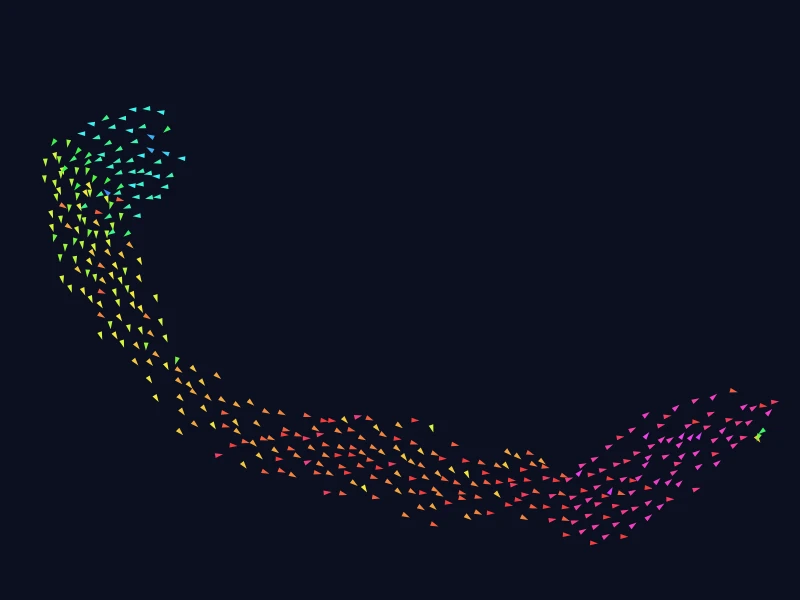
Nothing in these rules mentions a flock. A boid doesn't know where the flock is, how big it is or where it is going. Yet, from boids scattered at random, flocks appear, which fly, turn, split around obstacles and merge again, like real birds and fish.
Try it: switch the rules on and off
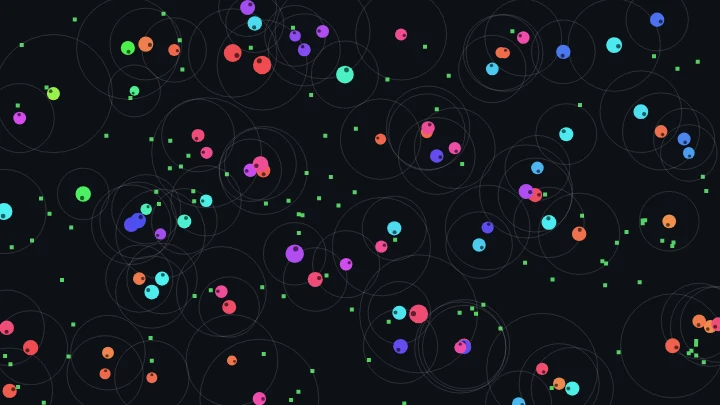
Below, 150 boids follow the three rules. Turn each rule off to see what it does, and hold the mouse button (or your finger) on the canvas to scare them. The white boid shows what it sees: its field of view (it can't see right behind itself), the dashed circle inside which it moves away from its neighbors, and a line to each neighbor it sees. It has no other information about the world.
Flocks: 0
Order: 0%
Average neighbors: 0.0
The order is 100% when all the boids fly in the same direction. Without alignment, the boids buzz around like gnats and the order drops. Without cohesion, they still fly together but drift apart. Without separation, they pile up on top of each other.
Our Boids tool has thousands of boids, predators, obstacles, every setting of the rules, and downloads as images and videos. Boids are not only a curiosity: the same idea animated the swarms of bats and the army of penguins of the film Batman Returns in 1992, and countless crowds in films and video games since.
Life on a grid
The oldest playground of artificial life is the cellular automaton: a grid of cells, where each cell changes its state by looking at its neighbors, following one simple rule. We have a whole article about them, Cellular automata, so here we only look at what they say about life.
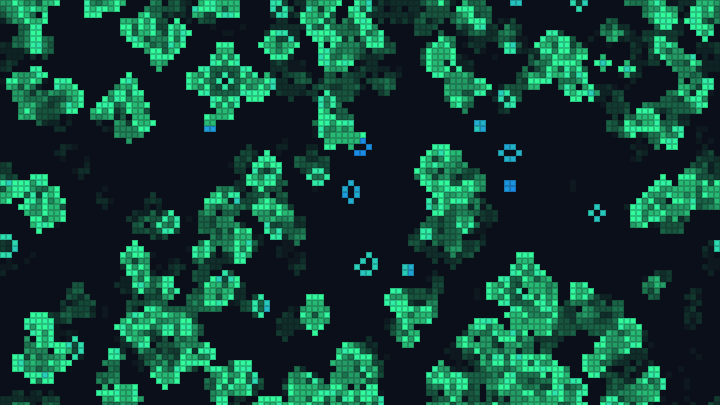
- The Game of Life - Invented by John Conway in 1970, it has only three rules, about how many neighbors a cell needs to be born, to survive or to die. From random cells, it produces "creatures" like the glider, a shape of 5 cells that walks across the grid forever. The glider is not made of the same cells for long: like a wave, it is a pattern that moves through the grid. In a way, living beings are like that too: they are patterns that persist while the matter they are made of flows through them. Try it in our Game of Life.
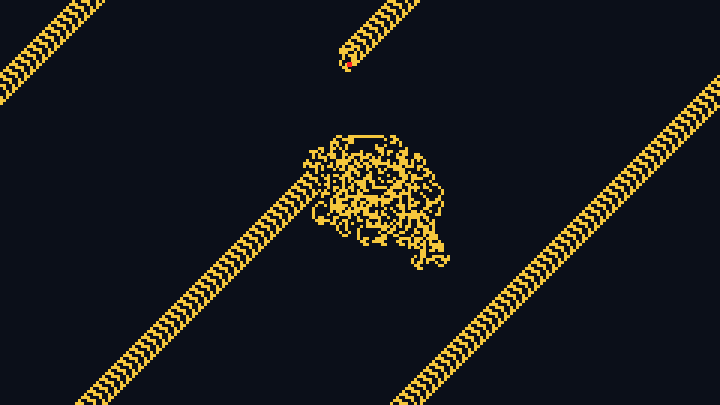
- Langton's ant - An ant on a grid follows two rules: on a white cell, turn right; on a black cell, turn left; and flip the color of the cell. For about 10,000 steps the ant draws a chaotic mess, and then, suddenly, it starts building a straight "highway" that goes on forever. Nobody can explain why from the rules alone. Try it in our Langton's Ant.
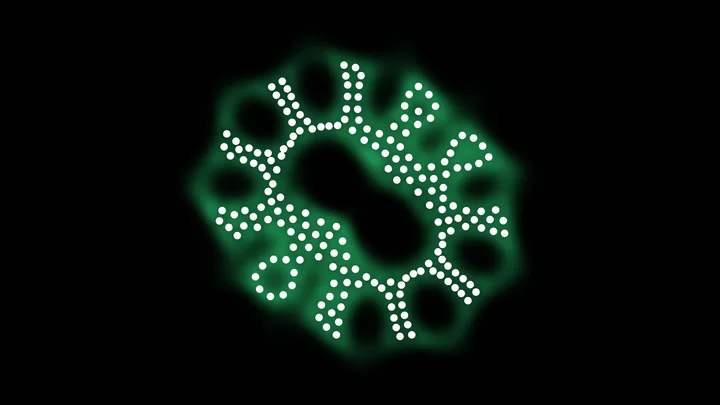
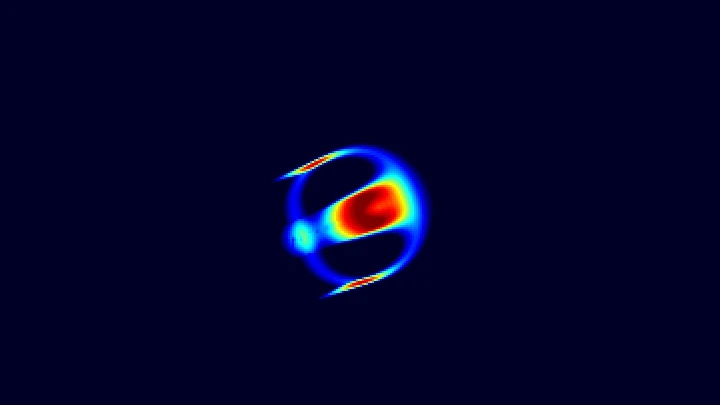
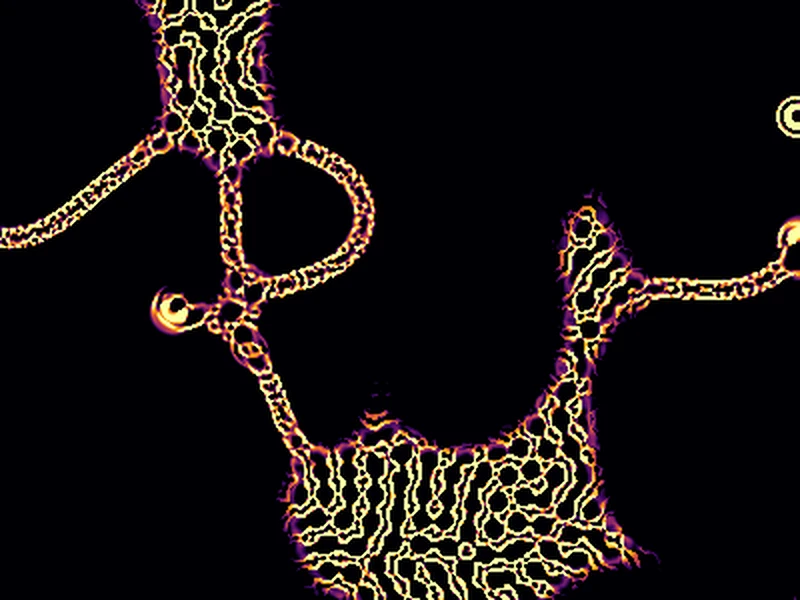
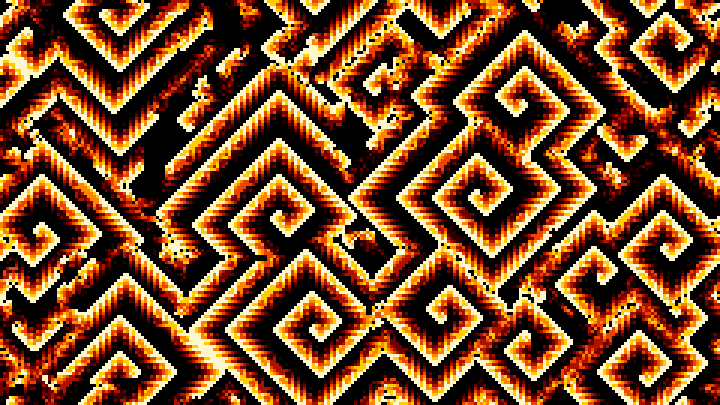
- Lenia and SmoothLife - When the cells can take any value between 0 and 1 instead of just alive or dead, and look at a large ring of neighbors, the creatures stop looking like pixels. SmoothLife (Stephan Rafler, 2011) has smooth gliders that fly in any direction. In Lenia (Bert Wang-Chak Chan, 2018), hundreds of creatures glide, spin, pulse and sometimes divide, and they look so much like microscopic organisms that Chan classified them into species, with Latin names. Try them in our Lenia and SmoothLife tools.
These worlds have a limitation: their creatures can't change. A glider is always a glider, and the creatures of Lenia only live with their own exact parameters. They show how lifelike shapes can emerge, but not how life evolves. For that, we'll need reproduction and heredity.
Life from particles
Real cells don't live on a grid. They are made of molecules that move freely and bump into each other. A newer family of simulations starts from particles that move in continuous space, each one following a simple rule about its neighbors:
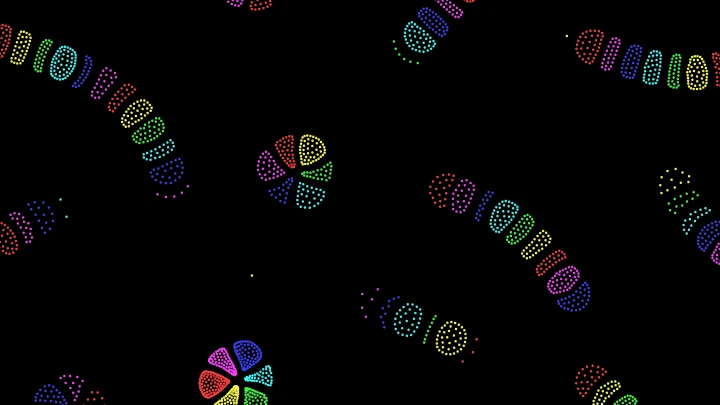
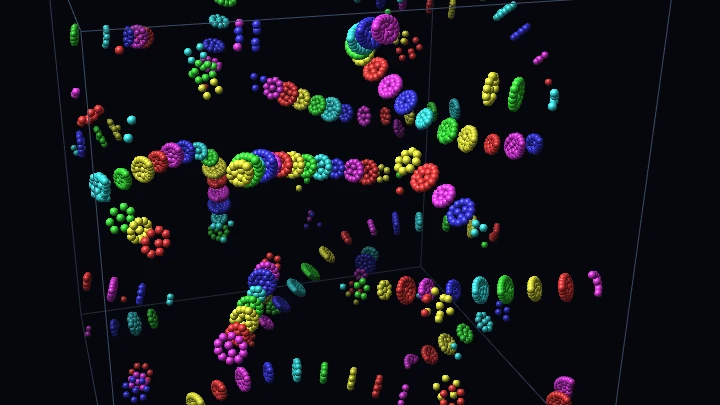
- Particle Life - Particles of several colors attract or repel each other, depending only on their colors: red may be attracted to green while green runs away from red. Because these forces are not mutual, the particles build cells, worms and swarms that chase each other and seem to have a purpose. The idea was made popular by Jeffrey Ventrella, Tom Mohr and Hunar Ahmad. Try it in our Particle Life and 3D Particle Life.
- The Primordial Particle System - Created by Thomas Schmickl, Martin Stefanec and Karl Crailsheim in 2016. Every particle moves forward at the same speed and does only one thing: it turns, by a fixed angle plus an angle for each neighbor, towards the side where it has more neighbors. From this single rule, cells appear that grow by catching free particles, and divide.
- Particle Lenia - Created at Google Research in 2022 by Alexander Mordvintsev, Eyvind Niklasson and Ettore Randazzo, it rebuilds the creatures of Lenia out of particles that move to lower their own energy. Try it in our Particle Lenia.
Try it: watch cells appear in a primordial soup
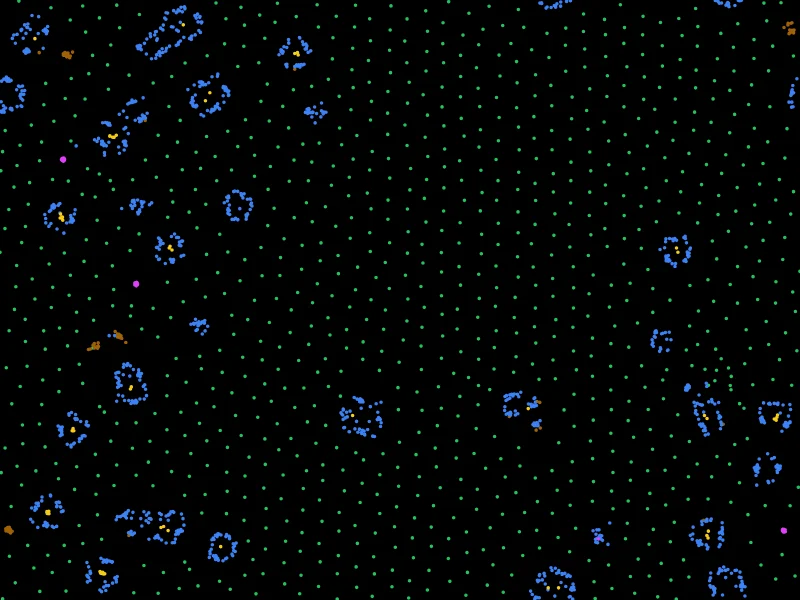
This is the Primordial Particle System, with the settings of the original article. The particles start spread at random. The colors show how crowded each particle is: green for free particles, then brown, blue and yellow for more and more crowded ones, and magenta for the dense cores of spores. After about a thousand steps, the first cells appear: blue rings with a yellow core, which eat the green particles around them and divide. Click on the canvas to drop a ready-made cell.
Step: 0
Cells: 0
Spores: 0
Nothing in the rule says "build a cell", "eat" or "divide". A cell is just a crowd of particles that happens to keep its shape, and it keeps its shape while its particles come and go, like a living cell. The full simulation, with other angles that give droplets, rings and liquids, is in our Primordial Particle System tool.
Machines that copy themselves
Reproduction looks like the most magical property of life. Can a machine build a copy of itself? It seems to lead to a paradox: to build a copy, the machine needs a description of itself, but that description is part of the machine, so it would need to describe the description, and so on forever.
In the late 1940s, the mathematician John von Neumann found the way out. He imagined a machine made of three parts and a tape:
The trick is that the tape is used in two different ways. First, the constructor reads it as instructions, and builds a new machine. Then, the copier copies it without reading it, and gives the copy to the new machine. The description never has to describe itself. And if the copier makes a mistake, the child gets a slightly different tape, and its own children will be different too: von Neumann's design also allows evolution.
Von Neumann worked this out before 1953, the year James Watson and Francis Crick discovered the structure of DNA, which works exactly like his tape: the cell reads its genes to build proteins, and copies them, unread, for its daughter cells. He built his machine in a cellular automaton with 29 states per cell, so large that it was never run completely in his lifetime. His work was published in 1966, after his death.
Others made self-copying patterns much smaller. In 1984, Christopher Langton designed Langton's loops: a loop of 86 cells with 8 possible states, carrying its description as a signal that circulates around it, which builds a copy of itself every 151 steps. Copies make copies, and the grid fills with a colony of loops, like a coral. Later versions were even smaller (John Byl's loop of 1989 has just 12 cells), and in 1999 Hiroki Sayama created the evoloop, whose loops can mutate and evolve. A simpler replicator exists in HighLife, a variant of the Game of Life (rule B36/S23, available in our Game of Life tool), where a small pattern makes copies of itself.
Evolution in a computer
Darwin's theory of evolution by natural selection needs only three ingredients, and none of them is specific to biology:
Since nothing in this cycle needs flesh and blood, it should work in a computer too. And it does:
- Barricelli's numbers (1953) - On one of the first computers, at the Institute for Advanced Study in Princeton, Nils Aall Barricelli let numbers copy themselves across the memory, compete and cooperate. It was the first evolution experiment ever run on a computer.
- Genetic algorithms (1970s) - John Holland showed how to use evolution as a way to solve problems: a population of candidate solutions is copied, mutated and mixed, and the best ones are kept. Today, evolutionary algorithms design antennas, timetables and machine parts.
- Tierra (1991) - The ecologist Thomas Ray wrote a single program of 80 instructions that copies itself in a virtual computer, and let it loose with random copying errors. Soon the memory was full of different "species". Then something nobody had programmed appeared: parasites of 45 instructions, too short to copy themselves, which borrowed the copying code of their neighbors. Then hosts evolved defenses against them, and parasites of the parasites appeared.
- Avida (1993) - Created by Charles Ofria, Chris Adami and C. Titus Brown, it rewards digital organisms with more computer time when they do small logic calculations, so they can copy themselves faster. In a famous study published in 2003, Richard Lenski and his colleagues watched complex functions evolve step by step, from simpler ones that were useful on their own, and showed that the path was different in every run.
- Karl Sims' creatures (1994) - Karl Sims evolved both the bodies and the brains of virtual creatures made of blocks, in a 3D world with physics. They evolved to swim, walk, jump and fight for a cube, often in ways no engineer would have designed.
Our Evolution Simulator lets you watch the cycle at work: creatures with genes for their speed, their size and their senses look for food, and split in two when they are full, passing slightly mutated genes to their children. Add predators, seasons or patches of food, and watch the genes of the population change to adapt.
Robots and chemistry
Hard artificial life is older than computers that could simulate it. Between 1948 and 1949, the neuroscientist William Grey Walter built two robot "tortoises", Elmer and Elsie, with just two artificial neurons each. They wandered around, moved towards light, and found their way back to their charging hutch when their batteries were low. Walter called the species Machina speculatrix.
In 1984, the neuroscientist Valentino Braitenberg published a little book, Vehicles, full of thought experiments about imaginary robots. The simplest ones have two light sensors and two wheels, and each sensor is wired directly to a wheel. Depending only on how the wires are connected, the vehicles seem to have feelings: fear, aggression, love, curiosity. Braitenberg's lesson is that it is much easier to build a behavior than to guess how a creature works by watching it.
Try it: drive with feelings
Choose a wiring, and drag the light around the canvas (or tap where you want it). Each vehicle draws a trail behind it.
Each sensor speeds up the wheel of the other side. The vehicle turns towards the light and speeds up as it gets closer, until it rams right through it.
Today, swarm robotics builds groups of hundreds of small robots that follow simple local rules, like boids or ants, to sort objects, explore or assemble shapes together.
Wet artificial life works with real chemistry. Researchers build protocells, little bubbles of fat that can grow and divide, as models of the first cells on Earth. In 2010, a team led by Craig Venter built the complete genome of a bacterium chemically, from scratch, and put it into a cell, which then lived and divided under the control of the synthetic genome. And in 2020, Sam Kriegman, Douglas Blackiston, Michael Levin and Josh Bongard presented xenobots: tiny living machines, less than a millimeter wide, made of skin and heart cells of the frog Xenopus laevis, with body shapes designed by an evolutionary algorithm in a computer. In 2021, the same team showed xenobots that gather loose cells into new xenobots, a new way of reproducing that no known organism uses.
A map of artificial life
The experiments of artificial life can be grouped by what they build: lifelike shapes on a grid, lifelike shapes from free particles, agents with behaviors, machines that copy themselves, populations that evolve, and life made of hardware or chemistry. The map below shows them, with a "Try it" link to each one you can run on this website. Click a group to jump to its explanation.
Artificial life
"life as it could be", built in computers, robots and chemistry
Agents that behave
- Flocks: boidsTry it
- Braitenberg vehicles
- Ant colonies and swarms
Life that copies itself
- Von Neumann's universal constructor
- Langton's loops
- The replicator of HighLifeTry it
Life that evolves
- Creatures with genesTry it
- Programs that evolve: Tierra and Avida
- Evolved bodies: Karl Sims' creatures
Hard and wet
- Robot tortoises
- Xenobots
- Synthetic cells
The groups overlap more and more as you go down the map. A Lenia creature is only a shape, but a cell of the Primordial Particle System also eats and divides, Langton's loops copy themselves, and the programs of Tierra copy themselves and evolve. Each step adds one more property from the list of what makes something alive.
The big open questions
In 2000, a group of researchers led by Mark Bedau published a list of the open problems of artificial life. Many are still open today. Here are some of the biggest:
- Open-ended evolution - Real evolution has kept inventing new things for almost four billion years: eyes, wings, brains, societies. Artificial evolution usually stalls: after a burst of novelty, the digital organisms of Tierra and Avida settle down, and nothing really new appears. Nobody knows exactly what ingredient is missing. It may be a richer world, more ways for organisms to interact, or bodies that can change in more ways.
- The origin of life - How did the first living thing appear from chemistry that was not alive? Simulations of particles and chemical reactions explore which simple systems can start to copy themselves.
- The edge of chaos - Langton noticed that the interesting cellular automata, the ones that can compute and build complex structures, lie between rules that freeze everything and rules that produce pure chaos. Is life always found at such a boundary? The idea is appealing, but still debated.
- Is it alive? - If a digital creature eats, reproduces and evolves, is it alive, or only a picture of life? Weak artificial life doesn't need to answer: simulations are useful either way. Strong artificial life says yes. The answer depends on whether life is defined by what it is made of, or by what it does.
A short history
- 1948-1949 - John von Neumann lectures on self-reproducing machines. William Grey Walter builds his robot tortoises.
- 1953 - Nils Aall Barricelli runs the first evolution experiments on a computer, in Princeton.
- 1966 - Von Neumann's Theory of Self-Reproducing Automata is published, completed by Arthur Burks.
- 1970 - John Conway invents the Game of Life.
- 1975 - John Holland publishes Adaptation in Natural and Artificial Systems, the founding book of genetic algorithms.
- 1984 - Valentino Braitenberg publishes Vehicles. Christopher Langton designs his self-copying loops.
- 1986 - Langton invents his ant, and Craig Reynolds creates boids.
- 1987 - The first workshop on artificial life, at Los Alamos, gives the field its name.
- 1991 - Thomas Ray's Tierra, where parasites evolve by themselves.
- 1993 - Avida is created at Caltech.
- 1994 - Karl Sims presents his evolved virtual creatures.
- 1999 - Hiroki Sayama's evoloop: self-copying loops that evolve.
- 2010 - A bacterium runs on a genome built from scratch in the laboratory.
- 2011 - Stephan Rafler's SmoothLife.
- 2016 - The Primordial Particle System.
- 2018 - Bert Wang-Chak Chan's Lenia and its creatures.
- 2020-2021 - Xenobots, living machines designed by a computer, and their new way of reproducing.
- 2022 - Particle Lenia.
Frequently asked questions
What is the difference between artificial life and artificial intelligence?
Artificial intelligence tries to build thinking: solving problems, understanding language, playing games. Artificial life tries to build living: staying alive, reproducing, evolving, behaving. Artificial intelligence often starts from the top, with the abilities of adult humans, while artificial life usually starts from the bottom, with simple parts, and lets complex behavior emerge. The two meet in topics like evolving robots and swarms.
Is a computer virus alive?
A computer virus copies itself and spreads, so it has one of the properties of life. But it doesn't keep itself together or use energy by itself, and it doesn't evolve: its copies are exact, and any change is made by a human programmer. It is closer to a biological virus, which is also usually not considered alive, than to a living cell.
Can a simulation ever be really alive?
Nobody knows, and it is one of the most debated questions of the field. If life is defined by what it is made of (carbon, water, proteins), then no simulation can be alive. If life is defined by what it does (keeping itself together, reproducing and evolving), then a simulation that does all of it might count. Today, no simulation does all of it as richly as real life.
Why don't the creatures of the Game of Life or Lenia evolve?
Because they don't copy themselves with variations. A glider is always exactly a glider, and a change to a Lenia creature usually kills it instead of creating a new species. Evolution needs a population of things that reproduce, with copies that are slightly different and still work. That's why self-copying patterns like Langton's loops, and especially loops that can mutate, like the evoloop, were such an important step.
Is artificial life dangerous?
Simulations are not: the creatures of this website can't leave your browser. Wet artificial life raises real questions, and the scientists who build synthetic cells and xenobots design them with safety in mind: for example, xenobots can't feed themselves and break down after a few days or weeks.
How can I experiment with artificial life myself?
Start with our artificial life tools. They all run in your browser, and you can change their rules while they run. A good path is: Boids for emergence, Game of Life and Lenia for life on a grid, Particle Life and the Primordial Particle System for life from particles, and the Evolution Simulator for evolution.
Further reading
- Artificial Life, in the Stanford Encyclopedia of Philosophy.
- Artificial life, Langton's loops and Tierra, on Wikipedia.
- Boids, the page of Craig Reynolds about his flocking model.
- The International Society for Artificial Life, which organizes the yearly ALife conference.
- Cellular automata, our article about grids of cells and their rules.
Related tools